

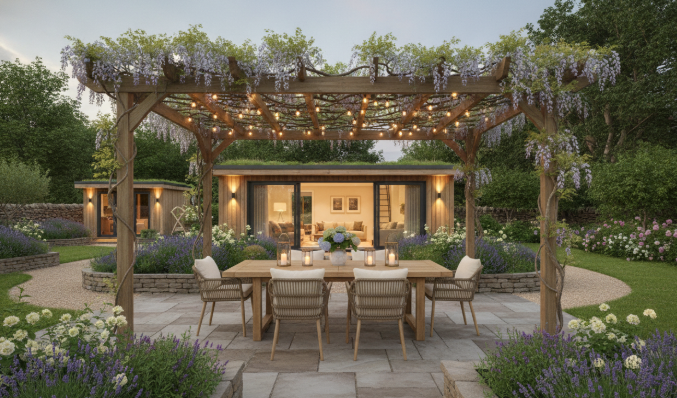
A big garden sounds like a luxury until you are standing in the middle of one on a Sunday afternoon wondering what half of it is actually for. The patio gets used, the shed gets used, and then there is a long stretch of grass that only ever sees the mower. That unused middle ground is the real problem with a large plot, and it is almost always a layout issue rather than a budget one. The fix is to stop treating the garden as one enormous space and start treating it as three or four smaller ones, each with a clear job.
Key Takeaways
- Three or four clearly defined zones fix most underused plots.
- A six-seat table needs around 3.5m by 3.5m of clear patio.
- A far-end seat facing the house is the cheapest big win.
- Paths, screening and lighting join the zones together.
- Finish one zone at a time rather than planning everything at once.
Stop Treating Your Garden as One Big Space
Zoning means giving each section a purpose and a boundary, even a soft one. Sketch the garden as a rectangle, mark the house, then divide it like this:
- Zone one, nearest the house: hard surfacing for eating and entertaining, within easy reach of the kitchen door.
- Zone two, the middle: lawn, planting or a play area, with something that draws the eye further down.
- Zone three, the far end: the working part of the garden, whether that is growing, storage, a workshop or a quiet seat that catches the evening sun.
On a square plot, divide side to side as well as front to back; quarters with a path crossing the middle give you four usable rooms instead of one flat blank.
A productive area need not be an allotment: four raised beds at 1.2m wide, a compost bay and a water butt will keep most households in salad, beans and herbs.
Children’s zones age out fast, so build them to be repurposed. A level bark area for a trampoline today becomes a firepit circle in eight years, and keeping it visible from the kitchen beats hiding it away.
Hobby space is where large gardens really earn their keep. Bike maintenance, pottery, weights or woodwork all need shelter, power and a floor that can take a beating, which is worth bearing in mind when you look at what a modern garden room can offer.
Start With What’s Closest
The most common mistake on big plots is a patio sized for a small one. A six seat table plus pulled out chairs needs somewhere around 3.5m by 3.5m of clear surface before you add a barbecue or a bench, so measure your furniture and add a metre all round.
If your existing patio is undersized, extending it in the same material is usually cheaper and calmer looking than adding a second seating area in something different. Porcelain, sawn sandstone and composite decking all work well in Hertfordshire’s wet winters, though anything smooth needs a decent slip rating if it sits in shade under trees.
Connect the Zones So You Actually Use Them
Zones only work if the route between them feels deliberate. Stepping stones, gravel or a mown strip through longer grass tells you where to walk, and a slight curve that hides the far end from the patio makes a long garden far more interesting.
For screening, use planting rather than more fencing. Pleached hornbeam, a beech hedge or a few multi stem amelanchier divide space without boxing it in and soften wind across an exposed plot. If you are unsure which species suits your soil and how often it will need cutting, the RHS hedging guide is a sensible starting point. Trellis with climbers does the same job faster on a tight budget.
Lighting stops the far zones going unused for half the year. Low level path markers, a couple of spots up lighting a tree and warm light at the second seating area are plenty. Avoid flooding the lawn: over lit gardens look like car parks and are poor news for local wildlife.
When a Permanent Structure Earns Its Place
If one of your zones needs to work all year, in the rain, with power and a lockable door, a garden building is the honest answer. Home offices, gyms, workshops and hobby studios all fall into that category, and putting one at the far end gives that dead space a permanent reason to exist.
Choosing the right structure for the intended use is worth thinking through carefully. Surrey Hills Garden Buildings offer a range of garden sheds and workshop-style structures designed to blend with the surrounding outdoor space, which is a useful reference point when comparing sizes, materials and configurations.
It is worth checking what you can build under permitted development and whether your plot has any restrictions before committing, as rules vary by property and local authority. For anything else, a pergola, a covered seating area or a decent store will often do the job for less.
Keep It Manageable
A large garden with new zones can quietly become new maintenance jobs. Be honest about how many hours a month you will realistically give it, then choose accordingly: gravel and shrubs over bedding plants, hedges over high maintenance topiary, and one well kept area rather than four half finished ones.
Start with the zone you will use most, finish it properly, and live with it for a season before moving on to the next. Gardens designed in stages tend to end up better than gardens designed all at once on paper.
Frequently Asked Questions
How much does it cost to zone a large garden in the UK?
A gravel path and a couple of raised beds can come in under £500 if you do the labour yourself. A professionally laid patio extension in porcelain or sandstone typically runs £1,500 to £4,000 depending on size and finish. Screening plants such as pleached trees cost more upfront but are a one-off spend, while fencing and trellis are cheaper now and need replacing later. Phasing the work zone by zone is the most budget-friendly approach.
Do I need planning permission for a new patio or path?
Usually not. Hard surfacing in a rear garden generally falls within permitted development. The main exception is front gardens, where paving over more than five square metres with a non-permeable surface needs permission unless water drains to a lawn or border. Conservation areas and listed properties have different rules, so check with your local authority first.
What type of outdoor lighting works best for garden paths and zones?
Low-level path lights on short stakes are the most practical for marking routes between zones, with spike spotlights for uplighting trees or a planted screen. For seating areas, wall lanterns or festoon lights give a warmer, more social feel than ground-level spots. Solar is fine for path marking and accent lighting, but a wired circuit with an outdoor socket is more dependable where you need reliable brightness.

